


Thanks to the upright gait, man became not only the pinnacle of evolution, but also got many problems.Due to the unnatural position of the body for a mammal, all the weight falls on the spine.Problems of the lumbosacral region are present in every third inhabitant of the planet.

What is osteochondrosis of the lumbar spine
The key problem of the spine in the lumbar region is that all the load during the day falls on this department.Combined with extreme mobility, the back is also subjected to extreme tests.The lumbar spine is destroyed due to dystrophic, deforming changes, the ligament apparatus weakens and loses elasticity, the discs are compressed, and the intervertebral distance decreases.In critical stages, the disease begins to heal with bone tissue, which pinches nerve endings.The result is pain.Symptoms of lumbar osteochondrosis
Symptoms of lower back problems appear slowly and over a long period of time.The diagnosis is often made in advanced forms of the disease, when periods of exacerbation are pronounced.Therefore, it is very important to know how to distinguish the signs of lumbar osteochondrosis from a random disease or the consequences of physical activity.The main symptoms of the disease are as follows:
- Lower back pain.No matter how trivial, this upcoming symptom should make you consider getting checked out.In the initial stages, pain may appear only after lifting weights, for example, but every time, constantly.As it develops, the pain will become constant, and at the time of the attack, it will become unbearable.
- Tight nerve endings significantly limit the ability to move in different directions.Bending, twisting or simply sitting can cause painful attacks that travel down the leg along the entire limb to the lower leg (resembling an electric shock).
- Gradual damage to the nerve roots causes a change in the sensitivity of the legs, and the symptom may increase or decrease.It is characterized by a sensation of burning, numbness, tingling, pins and needles from the sacrum and below.If you ignore this sign of the disease, it will cause muscle weakness and degradation of tendon reflexes.
- Local decrease in skin temperature, pallor, dryness, relaxation, pain.
- Increased sweating.
- Spinal syndrome.
- In extreme stages of the disease, sexual dysfunction and problems with urination are possible.
Initial stage of lumbar osteochondrosis
The initial stage of the disease is difficult to recognize due to the irregularity of the symptoms, which may resemble ordinary fatigue after exercise.The signs are exclusively orthopedic, but gradually the pain during the attack will become unbearable, and the manifestations of the disease will no longer correlate with physical activity.With a timely visit to a specialist, the treatment will last about 2 months and a few more until complete recovery.The primary signs of the disease are:
- pain in the lumbar region (nerve root irritation);
- painful shooting in the lower extremities, which may occur while walking;
- characteristic creaking and discomfort, especially often in the morning.
Lumbar osteochondrosis 2 degrees
According to experts, lumbar osteochondrosis of the 2nd stage has become the most common form of the disease among patients, since the first stage is rarely noticed by the patients themselves and is difficult to diagnose.The development of the disease causes new, more pronounced symptoms that follow the patient for many years before moving to the third stage.The symptoms of the second stage of the disease are as follows:
- lumbodynia and lumboischalgia;
- primary mobility of the spinal segment;
- primary destruction of the fibrous ring and adjacent tissues;
- nerve root compression;
- the distance between the vertebrae decreases;
- irritation of nerve endings
Lumbar osteochondrosis 3 degrees
Only 20 years ago, third-degree intervertebral disc degeneration was a disease of patients over 40 years of age.Today, the disease is significantly "younger".Osteochondrosis of the lumbar region of the 3rd degree is considered an extremely advanced stage of the disease, when therapeutic exercises and massage already have a minimal effect, and anti-inflammatory drugs and pain-relieving drugs become mandatory.The general symptoms of this stage are as follows:
- ischialgic scoliosis – tilting of the body from the source of the disease;
- numbness of the lower extremities;
- spinal deformity;
- radicular syndrome;
- formation of intervertebral hernias;
- destruction of the fibrous ring;
- persistent pain that spreads from the buttocks to the legs (outer thighs).
Osteochondrosis of the lumbar region 4 degrees

This is already an extreme degree of the disease, which can develop only if the symptoms are completely ignored for several decades.It is characterized by complete degradation and destruction of cartilage tissue, degenerative disc deformation.At this stage, the patient may be partially or completely paralyzed or lose mobility due to pain, even to the point of being declared disabled.Treatment of grade 4 lumbar osteochondrosis in most clinical cases is surgery with active drug support.
Worsening of lumbar osteochondrosis
Along with constant symptoms, exacerbations of lumbar osteochondrosis have a strong pain effect.Acute shooting pain (lumbago) due to pinched nerve roots immediately spreads from the lower back down the sciatic nerve.In critical cases, loss of sensation to the toes is possible.Acute lesions can disrupt the functioning of the pelvic system (incontinence, sexual dysfunction, constipation).The "cauda equina syndrome" is particularly dangerous;causes total loss of control below the point of disease.
Symptoms of lumbar osteochondrosis in women
With all similar symptoms, signs of lumbar osteochondrosis in women have their own specific characteristics.They are determined by the fact that the localization of the disease in the pelvic region has a negative impact on the female reproductive system.After the development of the second stage of the disease, the menstrual cycle changes (it can even be irregular and directly depends on exacerbations of osteochondrosis).During pregnancy, lumbar osteochondrosis can cause premature birth or miscarriage.Seasonal exacerbations in patients are also observed.
How to treat lumbar osteochondrosis
Treatment of lumbar osteochondrosis is a long process and requires an integrated approach.Based on the stage of the disease, its characteristics and the patient's personal tolerance, different types of treatment are prescribed.Drug treatment is designed only to relieve pain symptoms;the disease itself cannot be cured by medicine alone.The following methods are used to treat osteochondrosis of the lumbosacral spine:
- acupuncture to stimulate recovery responses;
- hirudotherapy;
- suppression of pathological processes;
- all types of therapeutic massage;
- vacuum effect for protrusions in the spine, in the presence of hernias.
-
Treatment regimen
The approach to the fight against lumbar osteochondrosis differs radically depending on the form of the disease.Some manipulations are unacceptable in the acute phase, but are useful during remission.Self-treatment in case of this disease is almost impossible.A set of exercises is selected and performed only by a professional massage therapist under the supervision of a specialist.
The treatment regimen for lumbar osteochondrosis in the acute phase is as follows:
- Complete relief from tension on the spine.In an ideal situation, arrange for the patient to rest exclusively in bed.For greater effect, it is better to use a special orthopedic mattress and pillows for the lower back and neck.
- Use of muscle relaxants.Compensation of pathological processes and pain will enhance the effect of the massage and relieve muscle tension.It is important to remember that these drugs have a sedative effect, so they should not be used by those whose work requires increased attention.
- Blocking injections based on novocaine or lidocaine are used to alleviate the consequences of pinching a large nerve.
The remission phase is treated according to the following scheme:
- The normalization of the conduction of nerve impulses and the renewal of the sheath of nerve endings takes place with the help of B vitamins.
- Vasodilators are used to normalize blood circulation in tissues.
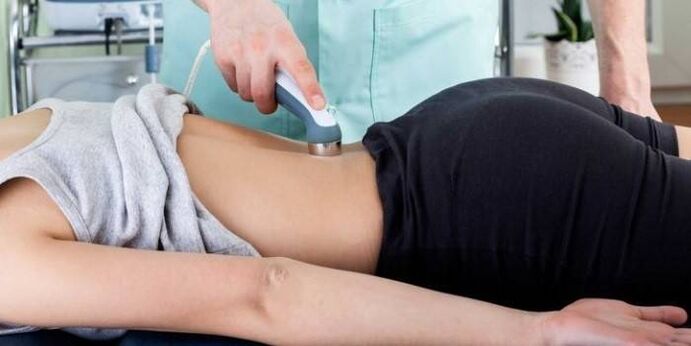
- Physiotherapy of various types aimed at preventing exacerbations.There are many variants: magnetotherapy, special baths, therapeutic massage, acupuncture.
- Exercise therapy is a mandatory part of rehabilitation therapy.Exercises are chosen individually for a specific case of the disease.Such training will help to form a muscular corset, reduce regular stress and restore natural mobility in the lower back.
First aid for lumbar osteochondrosis
When the patient can move independently, the first aid for lumbar osteochondrosis is to minimize the mobility of the lower back and protect against hypothermia.You can take painkillers, but in moderate doses so that the doctor can determine the intensity of the pain syndrome.Nothing more can be done without an examination by a specialist.
Treatment of osteochondrosis of the lumbar spine with drugs
The following drugs are divided into groups according to the mode of action.
- gels, creams and ointments – (they help relieve pain);
- non-steroidal anti-inflammatory drugs;
- NSAIDs;
- B vitamins.
Exercises
In the acute phase of the disease, any weight-bearing exercise is strictly contraindicated.Exercise therapy for osteochondrosis of the lumbar spine must be agreed with a doctor and carried out under his supervision.Experienced patients can exercise independently when they know the permissible limits of their own load.The set of exercises is selected individually, based on the intensity of the disease and location.
Massage
The use of massage for lumbar osteochondrosis remains a mandatory element of the course of treatment, therapy and prevention.It is necessary to remember that you should entrust the procedure only to reliable specialists after you have given the recommendations of your doctor.You can choose a classic or another type of massage yourself, but it is better to listen to the recommendations of experts in order to properly strengthen the musculoskeletal system.
Diet for lumbar osteochondrosis
Only a proper, balanced diet cannot cure the disease.Diet for lumbar osteochondrosis becomes an additional tool on the road to recovery.You should eat more foods high in B vitamins, animal protein and carbohydrates.It is necessary to limit the consumption of simple carbohydrates, salt, alcohol, coffee (tea), smoked food, pickles and spices.
Contraindications for osteochondrosis
Each disease has specific limitations that do not allow the use of different techniques and methods of treatment.Contraindications for osteochondrosis are associated with side effects: gastrointestinal dysfunction, mental disorders, blood and lung diseases, ischemic syndrome.Under these conditions, active massage and exercise therapy are strictly prohibited.Exercises are not prescribed in the presence of injuries, tumors, hematomas and similar formations.Active sports and strength training are prohibited.
Prevention of lumbar osteochondrosis
It is possible to cure problems with the lower back, but it is better to prevent them, so the prevention of lumbar osteochondrosis will be an excellent alternative to a visit to the doctor.There are a few basic rules, so taking care of the health of the spine is quite simple.Here's what to do to prevent lumbosacral osteochondrosis:
- do not overcool the lower back;
- during physical activity, lift and lower the load without jerking;
- do not carry too much weight;
- watch your posture;
- regularly change the position and do not allow the ridge to stagnate in one position;
- do physical exercises;
- try not to do heavy work in the wrong position and without proper preparation.